



What is Halal ?

Halal is an Arabic term in Islam which means permissible, allowed. Its antonym is Haram. According to the dietary rules of Islam, halal refers to the foods that are fit for Muslim consumption.
With the exception of fish, Muslims will only be allowed to consume the meat of the aforementioned animals if:
1. They are slaughtered by a believer in Allah
2. At the time of slaughter the slaughter man recites, “I begin with Allah’s name and Allah is the Greatest,” or at the very least, “I begin with Allah’s name.”
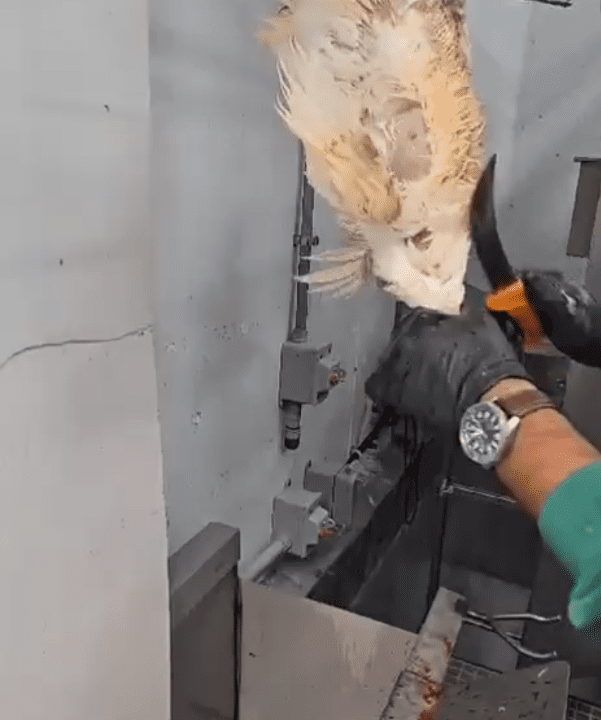
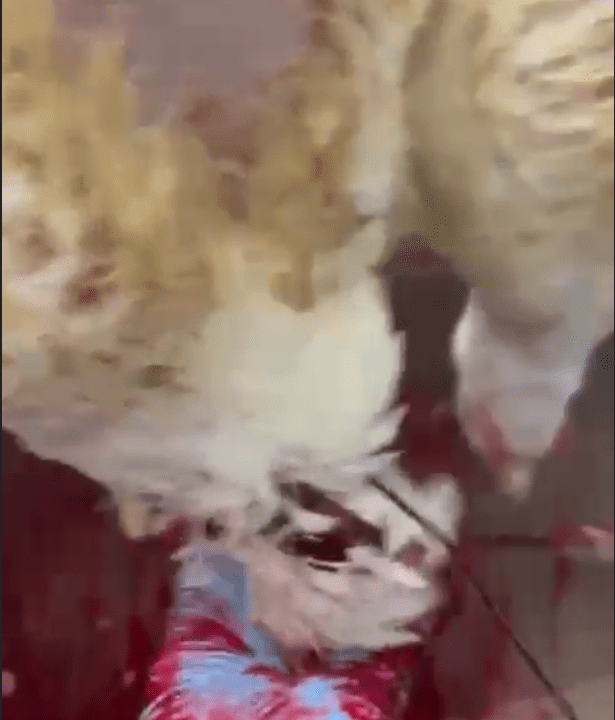
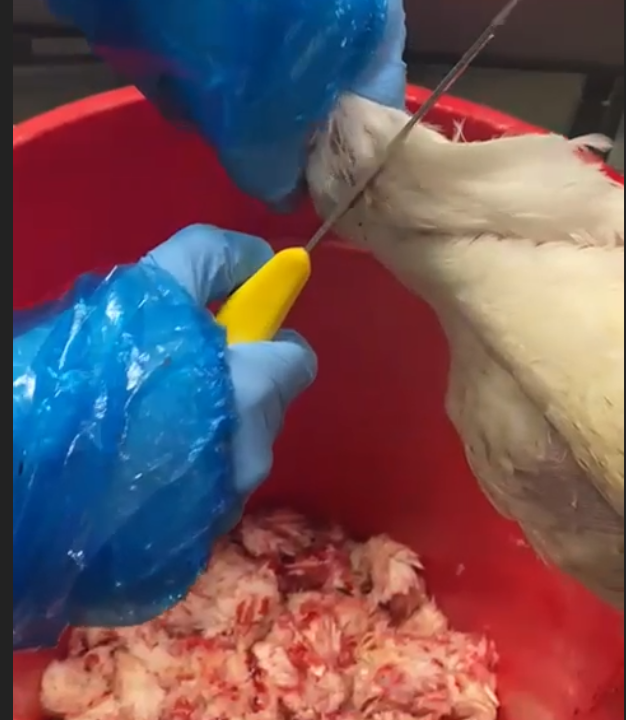
3. With a very sharp knife the slaughter man manually swiftly cuts the oesophagus, trachea and the two jugular veins of the animal in a single cut. In the event of him being unable to cut all four he must cut at least any three of them.
Muslims are also not allowed to have any intoxicants such as alcohol nor any blood.
Muslims are allowed to eat the meat of the following animals:
Muslims are not allowed to eat the meat of the following animals:
CONTROLLED ATMOSPHERE STUNNING (CAS)
“Controlled atmosphere stunning” is a name for the use of carbon dioxide or argon gas as part of the processing of chickens or other poultry for the production of human food. This procedure achieves insensibility by exposing broilers to either a mixture of inert gases (nitrogen and argon) or concentrations of carbon dioxide. The gas mixture deprives birds of oxygen, causing them to lose consciousness.
– http://www.nationalchickencouncil.org/national-chicken-council-brief-on-stunning-of-chickens
Temple Grandin from the Colorado State University states, “Controlled atmosphere stunning has several welfare advantages. Handling stress is reduced because live chickens no longer have to be hung on the shackles. Another welfare advantage is that when a gas system runs correctly, 100% of the chickens will be rendered insensible before shackling and bleeding. Small runt chickens that may miss a water bath stunner will be effectively stunned by the gas. Some systems may also improve meat quality.” http://www.grandin.com/gas.stunning.poultry.eval.html
Since CAS is an irreversible method of stunning, where the birds eventually do not recover, the Halal Monitoring Authority does not approve of it except when the following is guaranteed:
- The gas that is used is strictly C02
- The C02 exposure is regulated
- All birds remain alive at the time of slaughter
- All birds must be thoroughly bled prior to being scalded
- In the case where the line breaks down, all birds in the station until the slaughter bay will be condemned
- in the case where the CAS station is not functional, electric stunning will be applied
Click on the links below for CAS Updates:
Stunning is a convention used to render an animal immobile prior to slaughter. This has also been an area of controversy in recent times. There are multiple forms of stunning employed today:
CAPTIVE BOLT STUNNING
This method is typically used for cattle, sheep, lamb and goats. A captive bolt pistol is used to fire a bolt in to the animal’s skull which enters its cranium and damages its cerebrum thus rendering it completely unconscious. It is argued that this method is the most humane away of slaughtering an animal as it saves it from pain and agony during the slaughter. However studies clearly reveal the contrary:
Professor Schultz and his colleague Dr. Hazim of Hanover University, Germany, proved through an experiment, using an electroencephalograph (EEG) and electrocardiogram (ECG) that captive bolt stunning causes severe pain and agony to the animal. Details of the experiment are as follows:
1. Several electrodes were surgically implanted at various points of the skull of all animals, touching the surface of the brain.
2. The animals were allowed to recover for several weeks.
3. One group of animals was slaughtered by making a swift, deep incision with a sharp knife in the throat cutting the jugular veins of both sides along with the trachea and oesophagus.
4. Another group of animals was stunned using a captive bolt pistol prior to slaughter.
5. During the experiment, EEG and ECG were recorded on all animals to observe the condition of the brain and heart during stunning and slaughter.
The results of the experiment are as follows:
1. The first three seconds from the time of Islamic slaughter as recorded on the EEG did not show any change from the graph before slaughter, thus indicating that the animal did not feel any pain during or immediately after the incision.
2. For the following 3 seconds, the EEG recorded a condition of deep sleep – unconsciousness. This is due to a large quantity of blood gushing out from the body.
3. After 6 seconds, the EEG recorded zero level, showing no feeling of pain at all.
4. As the brain message (EEG) dropped to zero level, the heart was still pounding and the body convulsing vigorously (a reflex action of the spinal cord) driving maximum blood from the body: resulting in hygienic meat for the consumer.
Details of the study can be found here: http://www.scribd.com/doc/18968848/Conventional-Slaughtervs-Halal-A-Scientific-Examination#archive
A relatively more recent study shows that captive bolt stunning can scatter brain tissue throughout the body of the animal which in turn could serve as a means for mad-cow disease to spread in humans. Islamically this method is unacceptable as it contravenes the Prophet Muhammad’s instructions, “Indeed, Allah has prescribed proficiency in all things. […] So when you slaughter, you should sharpen your knife and then put the animal to rest.” (Sahih Muslim)
Cattle stun gun may heighten “Madcow’” risk
WATERBATH STUNNING
This system is the most commonly applied method in poultry abattoirs throughout Canada today. In this process, the birds’ heads are immersed into an electrified waterbath, causing the current to run through their head and body, thus either inducing unconsciousness or rendering them partially immobile. Stunned broilers normally regain consciousness and are able to maintain an erect posture within 120 seconds. Since this form of stunning is reversible and does not kill the bird prior to slaughter, provided the voltage remains low, it is acceptable to employ in order to ensure that the slaughter man makes an accurate cut.
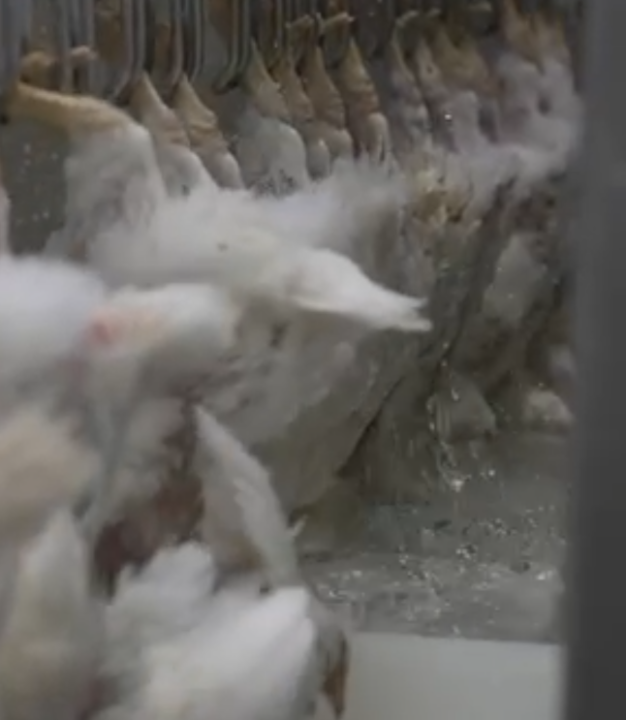
Machine slaughter is a convention that is typically used to slaughter poultry. Birds are slaughtered by being conveyed over a mechanical rotating blade at high speeds. The validity of this method for halal production has been debated by the Muslim community for several years now. Multiple observations show that this method is unacceptable to serve as halal slaughter for the following reasons:
1. The condition for the slaughter man to be a Muslim is compromised. Typically, in this type of operation, a person simply turns on the mechanical blade and then moves away from the area. He plays no role in the slaughter process thereafter.
2. Due to the swift speed of the slaughter, it is impractical to bless each and every single bird individually prior to slaughter. Hence many birds get slaughtered during the operation without being blessed at all. Hence, enacting verse 118 of chapter 6 in the Qurʾan becomes simply impractical.
3. The speed of the poultry production line is also a factor in many birds being cut improperly. It is for this very reason 1 to 2 men are always stationed after the rotating blade to sift out the improperly cut birds and complete the cut. Multiple observations have shown that human error does occur during this process and hence some birds are occasionally missed by the stationed men thus rendering them haram for consumption.
It is true that the sacred texts have not mentioned that the slaughter must be carried out manually by hand however it has given us clear guidelines to follow, which the machine slaughter method falls short of due to the aforementioned reasons. It is also worth noting that machine slaughter is not required to cater for the dietary needs of the growing Muslim community in Canada. Manually slaughtered poultry currently is and will continue to adequately meet the Muslim consumer demand with ease.
The following article provides more information on the problems surrounding machine slaughter: https://hmacanada.org/machine-slaughtered-meat/
Halal is important to Muslims because it is a divine dictate. Allah has issued the following orders in the Holy Qurʾān:
• “Mankind, eat whatever on the earth is lawful and good, and do not follow the footsteps of Satan. Indeed, he is a clear enemy to you.” (Chapter 2, verse 168)
• “Messengers, eat from the good foods [We have provided you] and perform righteous deeds.” (Chapter 23, verse 51)
• “You who believe, eat from the good things We have provided you and be grateful to Allah […].” (Chapter 2, verse 172)
• “So eat of that [meat] upon which Allah’s name has been taken, if you are believers in His verses.” (Chapter 6, verse 118)
• “And do not eat of that [meat] upon which Allah’s name has not been taken, for indeed, it is a grave sin.” (Chapter 6, verse121)
Compromising the dietary laws of Islam yields serious spiritual drawbacks. This is made clear in the following narrations:
• Abu Hurayrah reported, “The Prophet (peace be upon him) made mention of a man who undergoes a lengthy journey, dishevelled and dusty. He extends his hands to the sky [calling], ‘My Master, my Master.’ However his food is unlawful, his drink is unlawful, his clothes are unlawful, and he has been nourished with unlawful [foods]. So how will he be answered?” (Sahih Muslim)
• Saʿd reported, “Allah’s Messenger (peace be upon him) said, ‘Saʿd, make sure your food is pure. [By doing so] you will become one whose prayers are [always] answered. I swear by the Being in whose hands my soul lies, verily, [when] a servant [of Allah] throws down a haram morsel into his stomach, no deed of his is accepted [by Allah] for forty days.’” (Tabarani)
• Abu Bakr reported that Allah’s Messenger (peace be upon him) said, ‘That body will not enter paradise that has been nourished with haram.’” (Bayhaqī)
Halal Guidelines
- All animals must be healthy and must have no signs of physical trauma
- All animals must be treated in a humane manner. No animal can be beaten, abused or made to stay in traumatic conditions at any point.
- All animals must be given natural feed. Any animal given feed that is unacceptable to the authority must be quarantined for 72 hours prior to slaughter.
- All animals must be shielded from viewing the slaughter of another animal.
- No red meat animal can be hung upside down at the time of slaughter.
- Following the slaughter procedure, the animal must be given sufficient time to pass peacefully before its carcass can be cut and further processed.
- Birds that are fit for Muslim consumption are chickens, ducks, turkey, and quails.
- The person conducting the slaughter must be a Muslim of integrity. Where required, they will be trained and certified by the authority. A Muslim of integrity is a person who is honest and upholds the moral code of Islam and practices the teachings of the religion.
- The person conducting the slaughter must not be in the state of major ritual impurity.
- The bird should face the prayer direction (qiblah) during the time of slaughter. Exceptions to this rule can be made at abattoirs where operations currently exist, provided infrastructural modifications cause undue hardship for the company.
- Birds may be stunned by way of water bath provided the voltage simply renders them motionless and does not cause them to suffer any physical injury or die.
- Birds may be stunned upon the approval of the HMA through Controlled Atmospheric Stunning (CAS) provided the gas applied is strictly CO2, its exposure to the birds is regulated, the bird remains alive at the time of slaughter, its body temperature is the same as it was prior to being stunned and it bleeds the same amount as it would have had it been electrically stunned.
- The person conducting the slaughter must recite the Tasmiyah: “Bismillāhi wa Allāhu Akbar”, or at least “Bismillāh” upon every individual animal prior to slaughter without exception. (See Appendix A).
- The slaughterer will manually slaughter each bird with a knife that is sharp and in good condition. At no point will the person conducting the slaughter or any abattoir personal resort to slaughtering the birds mechanically with a mechanical rotating blade.
- Slaughterers will be stationed at the slaughter bay in a manner that no slaughterer slaughters more than 25 birds per minute. Adequate backup slaughterers must be available at the time of slaughter.
- All birds must be alive at the time of slaughter.
- The slaughterer will make the incision at the glottis and thus sever the esophagus, trachea and the two jugular veins without exception in a single cut.
- The animal to be slaughtered must be from the category of animals that are fit for Muslim consumption. (See Appendix B).
- The person conducting the slaughter must be a Muslim of integrity. They must be trained and certified by the council. A Muslim of integrity is a person who is honest and upholds the moral code of Islam and practices the teachings of the religion.
- The person conducting the slaughter must not be in the state of major ritual impurity.
- The person conducting the slaughter cannot employ any method of stunning, such as the captive bolt stunning prior to slaughter. Post cut stunning may be applied where required upon the approval of the halal authority.
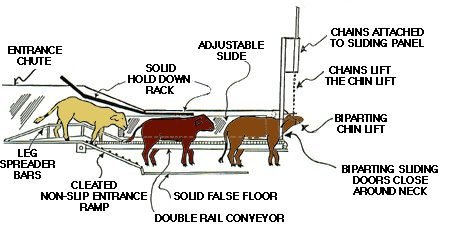
- Cattle will be slaughtered in a restraining box with their head placed in a head holder, which will raise the head at the time of slaughter to expose the throat. (See appendix C).
- The animal should face the prayer direction (qiblah) during the time of slaughter. Exceptions to this rule can be made at abattoirs where operations currently exist, provided infrastructural modifications cause undue hardship for the company.
- The person conducting the slaughter must recite Tasmiyah: “Bismillāhi wa Allāhu Akbar”, or at least “Bismillāh” upon every individual animal prior to slaughter without exception. (See Appendix A).
- The slaughterer will make the incision below the glottis and thus sever the esophagus, trachea and the two jugular veins without exception in a single swift cut. Sticking, poking, carrying out a vertical cut prior to the incision or doing a double cut during the slaughter will render the animal uncertified.
- The knife used by the slaughterer must by sharp, in good condition and larger than the area where the slaughterer will make the incision.
- Non-halal meat slaughter production and processing is not permitted in the same abattoir providing halal slaughter. Exceptions may be made in a facility where non-halal production takes place, provided halal slaughter is conducted on the first shift of the day on sanitized lines with sanitized equipment, and the sanitization procedures are approved by the HMA.
- All equipment used for cutting, hanging, transporting, further processing must be sanitized prior to halal production, and the sanitization procedures must be approved by the HMA.
- There must be no contact of halal meat with non-halal meat neither in the abattoir, processing area(s), freezers and chillers, nor at the time of packing, loading, unloading and transporting.
- Halal Meat must be stored separately from all non-halal meats at all times by either:
a) Storing it in a separate facility or,
b) Storing it in a separate compartment within the same facility. - In the event of halal meat being stored in the same facility as non-halal meat the following must be considered:
a) All loose halal meat must be packed and stored in an isolated corner of the facility so that no kind of contact is made with non-halal meat.
b) All halal meat must be labeled.
c) The handlers of halal meat must be versed with the issues of mixing, and must understand the basic rules of halal. - Meat imported from other vendors for halal production will not be certified by the HMA unless written approval has been granted by the HMA.
All seafood is considered halal by the HMA. Consumers who adhere to a particular school of Islamic Law (madhhab) should consult with their trusted scholar to see if any restrictions apply in their school.
- An ingredient will be considered Halal only if:
• It is plant based
• It is made from egg
• It is made from fish
• It is made from milk
• Its chemical source is halal
• Its synthetic source is halal
• Its animal-based ingredient is extracted from a dhabīḥah animal that meet the standards and guidelines set by the HMA
• It is not manufactured by using or coming into contact with non-halal items. - In a facility where non-halal production also takes place, the halal production must be conducted on the first shift of the day on sanitized lines with sanitized equipment.
- Ethanol use in the manufacturing of a non-protein product is permissible provided it is:
• Being used as a carrier and not as an active ingredient.
• Not derived from any source that is considered impure in Islam such as grapes, raisins and dates. - With the exception of fish and locusts, cold blooded animals such as reptiles, amphibians and insects are not fit for halal consumption. Hence, by-products from these animals are not permitted for use as an ingredient.
- Products, by-products, and ingredients from non-halal animals that are Genetically Modified Organisms (GMOs) are not halal and unfit for halal consumption.
- The packaging of halal products must be scheduled at the start of production shift, after a full sanitation cycle and pre-operational inspection has occurred.
- The equipment and utensils used (knives, racks, bins, shovels etc.) for packaging of halal products must be clean and sanitized to ensure there is no potential for cross contamination.
- Only halal products that are approved by the HMA inspector-designate are to be packed into HMA bearing packaging material.
- All packaging materials, product film used for halal products must be halal in nature and free from non halal bi-products or any material considered hazardous to human health.
- HMA logo usage and product labels must be approved by the HMA prior to printing.
Qur’anic Verses on the Compulsion of the Tasmiyah
• “So, eat that [meat] upon which Allah’s has been taken, if you are believers in His verses.” Chapter 6, verse 118
• “And why do you not eat that [meat] upon which Allah’s name has been taken when He has explained to you in detail everything that He has forbidden for you, except for that to which you are compelled. And indeed, many do lead [others] astray through their [own] inclinations without any knowledge. Indeed, your Lord – He is most knowing of the transgressors.” Chapter 6, verse 119
• “And do not eat [meat] upon which Allah’s name has not been taken, for indeed, it is grave disobedience. And indeed, the devils do inspire their allies [among men] to dispute with you. And if you were to obey them, indeed, you would be associating [others with Him].” Chapter 6, verse 121
Red Meats fit for Muslim Consumption
• Camels
• Cattle
• Sheep
• Goats
• Deer
• Bison
This method is typically used for cattle, sheep, lamb and goats. A captive bolt pistol is used to fire a bolt in to
the animal’s skull which enters its cranium and damages its cerebrum. Temple Grandin from the Department of Animal Science at Colorado State University writes, “A captive bolt stunning gun kills the animal and reduces it instantly unconscious without causing pain. A captive bolt gun has a steel bolt that is powered by either compressed air or a blank cartridge. The bolt is driven into the animal’s brain. It has the same effect on the animal as a firearm with a live bullet. After the animal is shot the bolt retracts and is reset for the next animal. A captive bolt gun is safer than a firearm.
There have been some questions about whether or not a captive bolt actually kills an animal. Practical experience in slaughter plants indicates that cattle shot correctly with a penetrating captive bolt have irreversible damage to their brain and they will not revive. If a non-penetrating captive bolt is used the animal may revive unless it is bled promptly.” https://www.grandin.com/humane/cap.bolt.tips.html
Definition of Halal and Haram
These two terms are important rulings in Islamic law. Halal is also technically known as mubāḥ or jā’iz (permissible, lawful, licit and legal). When Allah gives Muslims the choice to do or not do something, this option is called mubāḥ. There is no reward for carrying out the action while there is no punishment for failing to execute it.1 For instance, people can make different food choices and develop their personal tastes within the halal diet itself. People are allowed to do many things for which they will not be held accountable.
However, in cases of emergency or idtirār, a forbidden (haram) act can become permissible (mubāḥ) in order to preserve human life which is of a higher priority.
Halal, or Mubāḥ, constitutes the largest area of Islamic law because it encompasses all human acts except for what Allah has highlighted as being bad, which must be avoided. One important Islamic jurisprudential maxim states, ‘All acts are considered permissible unless communicated otherwise by Allah.’ In order to consider an act permissible (mubāḥ), it should be either;
• Declared explicitly or implicitly as permissible by Allah,
• Be based on a Prophetic tradition (Sunnah),
• Or simply be permissible by default, common sense or customs.
The opposite of the permissible is haram, (prohibited, unlawful or forbidden act) also known as al-muḥarram oral-mahẓūr. An act is considered ḥaram when the prohibition is decisive (ṭalab jāzim) and one who commits the act is considered a sinner. If the haram action is avoided, the person will be rewarded. The injunction of prohibition (taḥrīm) uses the word haram or a verb from the same derivation or other terms that
• Denote prohibition,
• Communicate a clear command to avoid a certain conduct,
• Promises a punishment for disobeying.2
What is Halal and Pure food?
The Qur’an says, “They ask you what is lawful for them [to consume]. Say, “Lawful for you are (all) things that are good and pure […]”3
Food that is permissible for Muslims to consume is called “Halal” food. Most people in the West are familiar with the word “Kosher”, but it is not totally the same thing. In general, as mentioned before, all food is halal except
1Al-Shāṭibī, al-Muwāfaqāt 1:76.
2Zīdān, al-Wajīz, p. 41.
3Qur’an 5:4
what is mentioned as haram in the primary sources of Islamic law – the Qur’an and the Sunnah. Therefore, it is easier to mention what is haram (unlawful) than to state all that is allowed to be consumed. However, there is sometimes some confusion over whether a certain product is haram or halal. This falls in the “Grey area” category that is known as “doubtful”, or Mush’tabah. The Messenger of Allah (peace be upon him.) said in this
regard,
“Halal is clear and Haram is clear. Between the two of them are doubtful matters which many people do not know of. Thus, whoever avoids doubtful matters keeps himself clear in his religion and honour. But whoever falls into doubtful matters will [eventually] fall into what is unlawful […]”.4
What is Haram?
As mentioned before, Haram items are very few relatively speaking. Allah says, “Say Muhammad, ‘I do not find in the message sent to me by revelation any (meat) forbidden to be eaten by one who wishes to eat it, unless it is dead meat, or blood poured forth, or the flesh of swine – for it is an abomination – or what is impious, (meat)
on which a name has been invoked other than Allah’s.” But (even so), if a person is forced by necessity, without willful disobedience, nor transgressing due limits, your Lord is Oft-Forgiving, Most Merciful’”.5
“He has only forbidden for you dead meat, and blood, and the flesh of swine, and any (food) over which the name of other than Allah has been invoked. But if one is forced by necessity, without willful disobedience, nor transgressing due limits, then Allah is Oft-Forgiving, Most Merciful”.6
“He has only forbidden you dead meat, and blood, and the flesh of swine, and that on which any other name has been invoked besides Allah’s. But if one is forced by necessity, without willful disobedience, nor transgressing due limits, then is he guiltless. For Allah is Oft-Forgiving, Most Merciful”.7
In short, most issues pertaining to Halal and Haram food are related to meat and how they are prepared from beginning to end. A brief description of each category of Haram food is as follows:
1. The meat of an animal that is not slaughtered by a Muslim or by the People of the Book in accordance
to Mosaic Law is not permissible. Allah says, “Today, (all) good and pure things are made permissible
for you. The food of the People of the Book is permissible for you and your food is permissible for them”.8
For instance, if a person who does not believe in God performs the slaughter, then the meat becomes
prohibited for Muslims to consume.
The meat of an animal that dies before being slaughtered cannot be eaten by a Muslim because it is
4Bukhari & Muslim
5.Qur’an.6 :145
6.Qur’an 16 :115
7.Qur’an.2 :173
8.Qur’an 5 :5
considered Carrion. All meats from dead animals are haram to consume.
2. Pork and anything derived from it such as bacon, lard, ham, and other pig by-products are prohibited. This means that any food that has ingredients such as gelatin and pepsin, or food, which was seasoned with pork or its derivatives, and any other food items having come into contact with pork or pork by products, is unlawful to eat. Gelatin is usually made from the skin and bones of an animal. Gelatin itself is not prohibited – for example, halal gelatin from animals such as cow, sheep etc., slaughtered according to the religious requirement can be consumed. Since cheese requires enzymes, pepsin etc., which are derived from pork, only halal cheese can be consumed. Also, some brands of bread, cookies, doughnuts, cakes and other baked goods could contain lard. Therefore, its ingredients must be verified.
3. Meat of carnivores is haram (not permissible). Muslims can eat beef, chicken, pigeon, turkey, duck, lamb, goat, deer, and many similar animals, which do not consume meat and birds. The Prophet (peace be upon him) forbade every beast having a fang and every bird having a talon.9
4. A food or a drink, which contains alcohol or alcoholic by-products, is haram. All wine, beer, liquor, and narcotics are unlawful for consumption whether in large or small amounts (even in cooking). In brief, any intoxicant whether a liquor or a drug is haram to consume.
Allah says, “You who believe, intoxicants and gambling, (dedication of) stones, and (divination by) arrows, are an abomination of Satan’s handiwork: eschew such (abomination), that you may prosper”.10
5. Flowing blood and its derivatives are haram.11
6. Dead animals or birds that have died a natural death are haram. They are considered impure and thus not allowed to eat except in the case of dead fish unless it is proven medically harmful due to pollution or any kind of poisoning.
7. Foods that contain certain types of ingredients extracted from unlawful sources such as dead animals or pork are also haram. The Muslim must do his/her best to avoid anything suspicious and must investigate carefully about enzymes, lecithin, L-cysteine, mono and di-glycerides, shortenings, minerals, vitamins etc.,
9. Muslim and others
10. Qur’an 5 :90
11. Qur’an 6 :145
8. Any halal food, which was not kept isolated from haram food and was contaminated, cannot be consumed. The Prophet (peace be upon him) said, “Abandon whatever puts you in doubt for that which does not put you in doubt”.12
9. Meat or food, which was offered and dedicated to any god other than Allah. Allah says, “He has only forbidden you from dead meat, blood, the flesh of swine, and that on which any other name has been invoked besides that of Allah”13
This is the reason why Muslims must mention the name of Allah while slaughtering because it is an act of worship, regardless of whether it is a sacrifice or a routine act for meat consumption; All slaughter should be by the blessing of Allah who says, “Eat not of [meats] on which Allah’s name has not been pronounced; that would be impiety.”14
Most importantly, in addition to the above, any food that was stolen by any means or was purchased with stolen or unlawful money (obtained from gambling, cheating, fraud etc.,) is haram to eat. The concept of lawful and unlawful is not just restricted on the substance and kind of food; it must also be gained through legitimate means whether through work, given as a gift, charity, or offered by family, friends or people.
12. Tirmidhi and Nasa’i
13. Qur’an 2 :173
14. Qur’an 6 :121
Featured companies and partners


















Click on the Fatawas below to view:
Despite the owner’s initial view to the contrary, you can separate the goodwill in your business from yourself and place a saleable value on it.
WHY IS HALAL IMPORTANT TO MUSLIMS?
Halal is important to Muslims because it is a divine dictate. Allah has issued the following orders in the Holy Qurʾān:
• “Mankind, eat whatever on the earth is lawful and good, and do not follow the footsteps of Satan. Indeed, he is a clear enemy to you.” (Chapter 2, verse 168)
• “Messengers, eat from the good foods [We have provided you] and perform righteous deeds.” (Chapter 23, verse 51)
• “You who believe, eat from the good things We have provided you and be grateful to Allah […].” (Chapter 2, verse 172)
• “So eat of that [meat] upon which Allah’s name has been taken, if you are believers in His verses.” (Chapter 6, verse 118)
• “And do not eat of that [meat] upon which Allah’s name has not been taken, for indeed, it is a grave sin.” (Chapter 6, verse121)
Compromising the dietary laws of Islam yields serious spiritual drawbacks. This is made clear in the following narrations:
• Abu Hurayrah reported, “The Prophet (peace be upon him) made mention of a man who undergoes a lengthy journey, dishevelled and dusty. He extends his hands to the sky [calling], ‘My Master, my Master.’ However his food is unlawful, his drink is unlawful, his clothes are unlawful, and he has been nourished with unlawful [foods]. So how will he be answered?” (Sahih Muslim)
• Saʿd reported, “Allah’s Messenger (peace be upon him) said, ‘Saʿd, make sure your food is pure. [By doing so] you will become one whose prayers are [always] answered. I swear by the Being in whose hands my soul lies, verily, [when] a servant [of Allah] throws down a haram morsel into his stomach, no deed of his is accepted [by Allah] for forty days.’” (Tabarani)
• Abu Bakr reported that Allah’s Messenger (peace be upon him) said, ‘That body will not enter paradise that has been nourished with haram.’” (Bayhaqī)
WHAT IS MACHINE SLAUGHTER?
Machine slaughter is a convention that is typically used to slaughter poultry. Birds are slaughtered by being conveyed over a mechanical rotating blade at high speeds. The validity of this method for halal production has been debated by the Muslim community for several years now. Multiple observations show that this method is unacceptable to serve as halal slaughter for the following reasons:
1. The condition for the slaughter man to be a Muslim is compromised. Typically, in this type of operation, a person simply turns on the mechanical blade and then moves away from the area. He plays no role in the slaughter process thereafter.
2. Due to the swift speed of the slaughter, it is impractical to bless each and every single bird individually prior to slaughter. Hence many birds get slaughtered during the operation without being blessed at all. Hence, enacting verse 118 of chapter 6 in the Qurʾan becomes simply impractical.
3. The speed of the poultry production line is also a factor in many birds being cut improperly. It is for this very reason 1 to 2 men are always stationed after the rotating blade to sift out the improperly cut birds and complete the cut. Multiple observations have shown that human error does occur during this process and hence some birds are occasionally missed by the stationed men thus rendering them haram for consumption.
It is true that the sacred texts have not mentioned that the slaughter must be carried out manually by hand however it has given us clear guidelines to follow, which the machine slaughter method falls short of due to the aforementioned reasons. It is also worth noting that machine slaughter is not required to cater for the dietary needs of the growing Muslim community in Canada. Manually slaughtered poultry currently is and will continue to adequately meet the Muslim consumer demand with ease.
The following article provides more information on the problems surrounding machine slaughter: https://hmacanada.org/machine-slaughtered-meat/
WHAT IS STUNNING?
Stunning is a convention used to render an animal immobile prior to slaughter. This has also been an area of controversy in recent times. There are multiple forms of stunning employed today:
CAPTIVE BOLT STUNNING
This method is typically used for cattle, sheep, lamb and goats. A captive bolt pistol is used to fire a bolt in to the animal’s skull which enters its cranium and damages its cerebrum thus rendering it completely unconscious. It is argued that this method is the most humane away of slaughtering an animal as it saves it from pain and agony during the slaughter. However studies clearly reveal the contrary:
Professor Schultz and his colleague Dr. Hazim of Hanover University, Germany, proved through an experiment, using an electroencephalograph (EEG) and electrocardiogram (ECG) that captive bolt stunning causes severe pain and agony to the animal. Details of the experiment are as follows:
1. Several electrodes were surgically implanted at various points of the skull of all animals, touching the surface of the brain.
2. The animals were allowed to recover for several weeks.
3. One group of animals was slaughtered by making a swift, deep incision with a sharp knife in the throat cutting the jugular veins of both sides along with the trachea and oesophagus.
4. Another group of animals was stunned using a captive bolt pistol prior to slaughter.
5. During the experiment, EEG and ECG were recorded on all animals to observe the condition of the brain and heart during stunning and slaughter.
The results of the experiment are as follows:
1. The first three seconds from the time of Islamic slaughter as recorded on the EEG did not show any change from the graph before slaughter, thus indicating that the animal did not feel any pain during or immediately after the incision.
2. For the following 3 seconds, the EEG recorded a condition of deep sleep – unconsciousness. This is due to a large quantity of blood gushing out from the body.
3. After 6 seconds, the EEG recorded zero level, showing no feeling of pain at all.
4. As the brain message (EEG) dropped to zero level, the heart was still pounding and the body convulsing vigorously (a reflex action of the spinal cord) driving maximum blood from the body: resulting in hygienic meat for the consumer.
Details of the study can be found here: http://www.scribd.com/doc/18968848/Conventional-Slaughtervs-Halal-A-Scientific-Examination#archive
A relatively more recent study shows that captive bolt stunning can scatter brain tissue throughout the body of the animal which in turn could serve as a means for mad-cow disease to spread in humans. Islamically this method is unacceptable as it contravenes the Prophet Muhammad’s instructions, “Indeed, Allah has prescribed proficiency in all things. […] So when you slaughter, you should sharpen your knife and then put the animal to rest.” (Sahih Muslim)
Cattle stun gun may heighten “Madcow’” risk
WATERBATH STUNNING
This system is the most commonly applied method in poultry abattoirs throughout Canada today. In this process, the birds’ heads are immersed into an electrified waterbath, causing the current to run through their head and body, thus either inducing unconsciousness or rendering them partially immobile. Stunned broilers normally regain consciousness and are able to maintain an erect posture within 120 seconds. Since this form of stunning is reversible and does not kill the bird prior to slaughter, provided the voltage remains low, it is acceptable to employ in order to ensure that the slaughter man makes an accurate cut.
CONTROLLED ATMOSPHERE STUNNING (CAS)
“Controlled atmosphere stunning” is a name for the use of carbon dioxide or argon gas as part of the processing of chickens or other poultry for the production of human food. This procedure achieves insensibility by exposing broilers to either a mixture of inert gases (nitrogen and argon) or concentrations of carbon dioxide. The gas mixture deprives birds of oxygen, causing them to lose consciousness.
– http://www.nationalchickencouncil.org/national-chicken-council-brief-on-stunning-of-chickens
Temple Grandin from the Colorado State University states, “Controlled atmosphere stunning has several welfare advantages. Handling stress is reduced because live chickens no longer have to be hung on the shackles. Another welfare advantage is that when a gas system runs correctly, 100% of the chickens will be rendered insensible before shackling and bleeding. Small runt chickens that may miss a water bath stunner will be effectively stunned by the gas. Some systems may also improve meat quality.” http://www.grandin.com/gas.stunning.poultry.eval.html
Since CAS is an irreversible method of stunning, where the birds eventually do not recover, the Halal Monitoring Authority does not approve of it except when the following is guaranteed:
- The gas that is used is strictly C02
- The C02 exposure is regulated
- All birds remain alive at the time of slaughter
- All birds must be thoroughly bled prior to being scalded
- In the case where the line breaks down, all birds in the station until the slaughter bay will be condemned
- in the case where the CAS station is not functional, electric stunning will be applied
Click on the links below for CAS Updates: